UG
UGBosch ME7.5 · Audi A4 B6 · 1.8T
ME7Tune
B6 A4
The B6 shipped two different ME7.5 calibrations and they do not share addresses, so there is a build for each. Nothing else on the market covers this platform. Open your bin, change the maps, export it checksum-fixed, write it back over OBD.
Windows 10 / 11 · No dongle · Nothing phones home
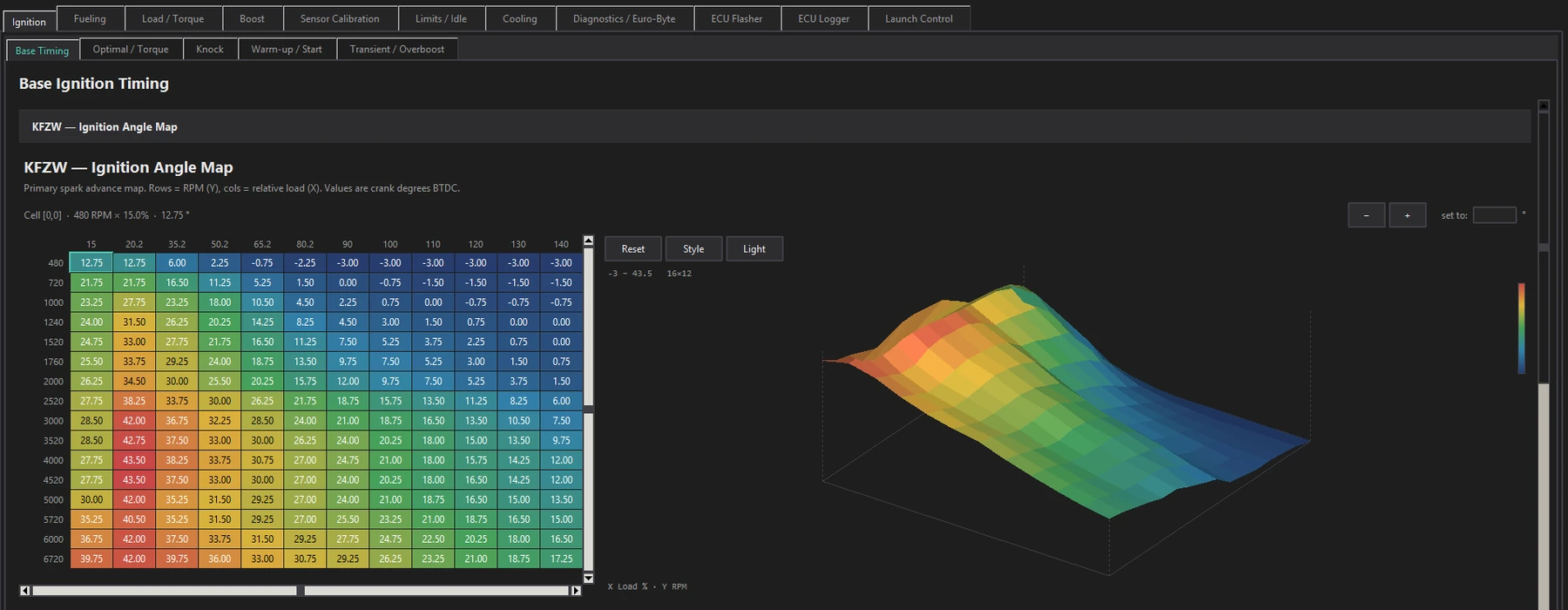
KFZW base ignition. Table and surface side by side, so you can see what a change did to the shape before you flash it.
What’s
inside
Eleven tabs over one file and one cable: ignition, fueling, load and torque, boost, sensor calibration, limits and idle, cooling, diagnostics, flasher, logger, launch control. The flasher and the logger arbitrate the cable between them, so neither can cut the other off mid-operation.
Fueling
Injectors sized for you
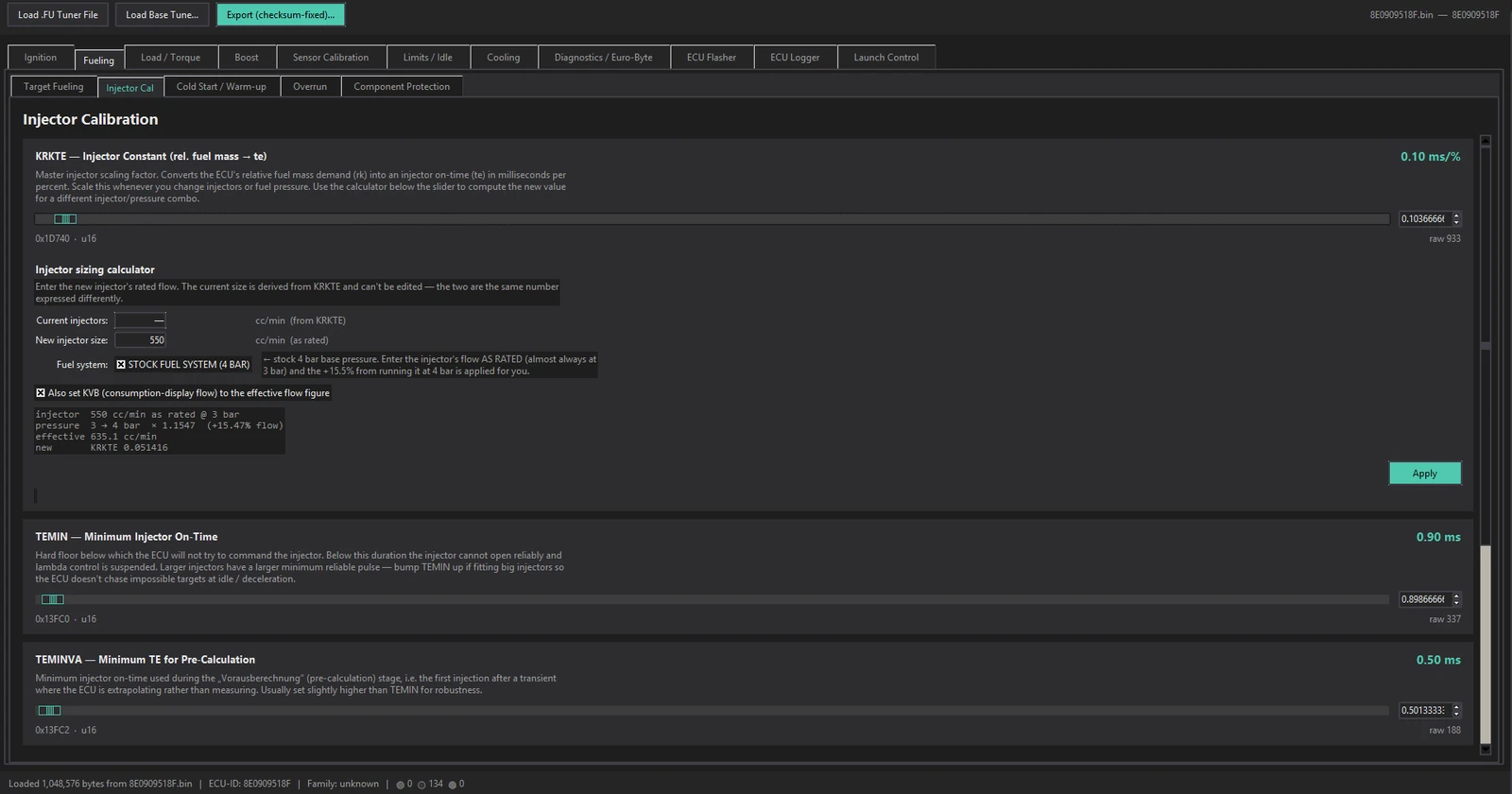
KRKTE is the number people get wrong. Type in what the new injectors are rated at, tell it whether the stock 4 bar system is in play, and it works out the effective flow and the new constant. TEMIN and TEMINVA sit on the same page so the ECU stops chasing pulse widths the injector cannot deliver.
- KRKTE injector constant and sizing calculator
- Rated-flow to effective-flow correction at 4 bar
- TEMIN / TEMINVA minimum on-time
- TVUB voltage correction, so a low battery does not lean it out
- KFNSA post-start and KFFWL warm-up enrichment
- BTS exhaust-temp enrichment and KFDLBTS lambda delta
Load & torque
The chain from pedal to boost
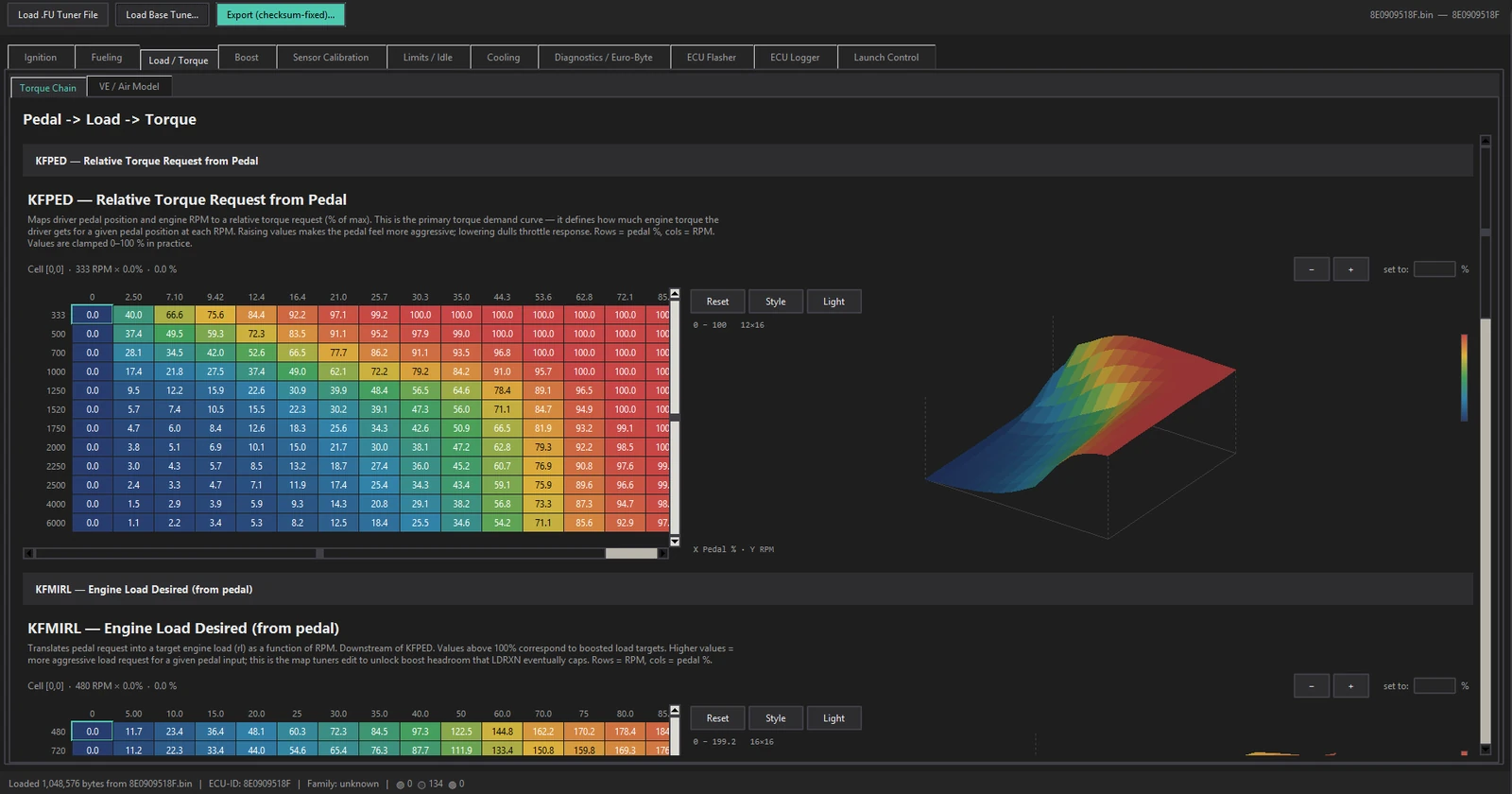
KFPED turns pedal into a torque request, KFMIOP caps that request, KFMIRL converts what survives into a load target, and LDRXN caps that in turn. Raise the last column of KFMIRL on its own and nothing happens, because stock KFMIOP tops out below 90% and the request never gets that high. Seeing the whole chain on one page is how you stop chasing a limit that lives two maps upstream.
- KFPED — pedal to relative torque request
- KFMIOP — the cap on requested torque
- KFMIRL — torque request to specified load
- KFTARX — max load pulled back as intake temps climb
- VE model: throttle, cylinder pressure, residual gas
Boost
See the ceiling, not just the numbers
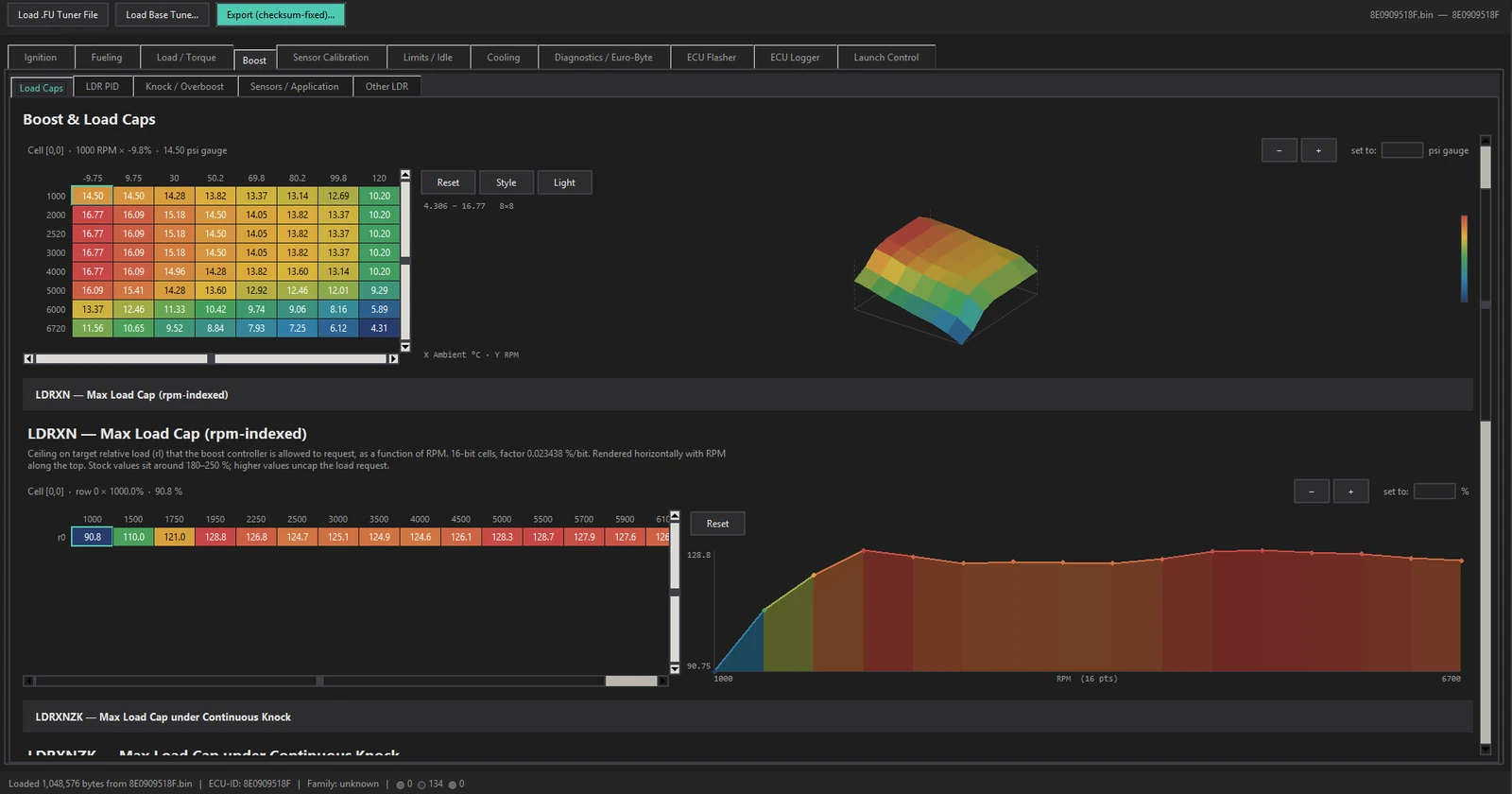
ME7 has no boost table. It works in specified load, and LDRXN is the ceiling on it — roughly ten times the value plus 300 mbar absolute, give or take a lot. Far easier to judge as a line than as sixteen cells, which matters because the stock K03 curve ramps harder than a K04 can follow, and asking for boost the turbo cannot make is how you end up in positive-deviation limp.
- LDRXN plotted against RPM, plus LDRXNZK under knock
- LDORXN fault-mode cap, LDPBN high-temp pressure limit
- KFLDIMX — the I-limit that actually sets steady-state duty
- KFLDRL post-PID linearisation, Q0/Q1/Q2 gains
- STLDIA adaptation ranges, movable for slower-spooling turbos
- MAP sensor rescaled past ME7’s ~2560 mbar internal ceiling
Sensor calibration
Bigger housing, correct numbers
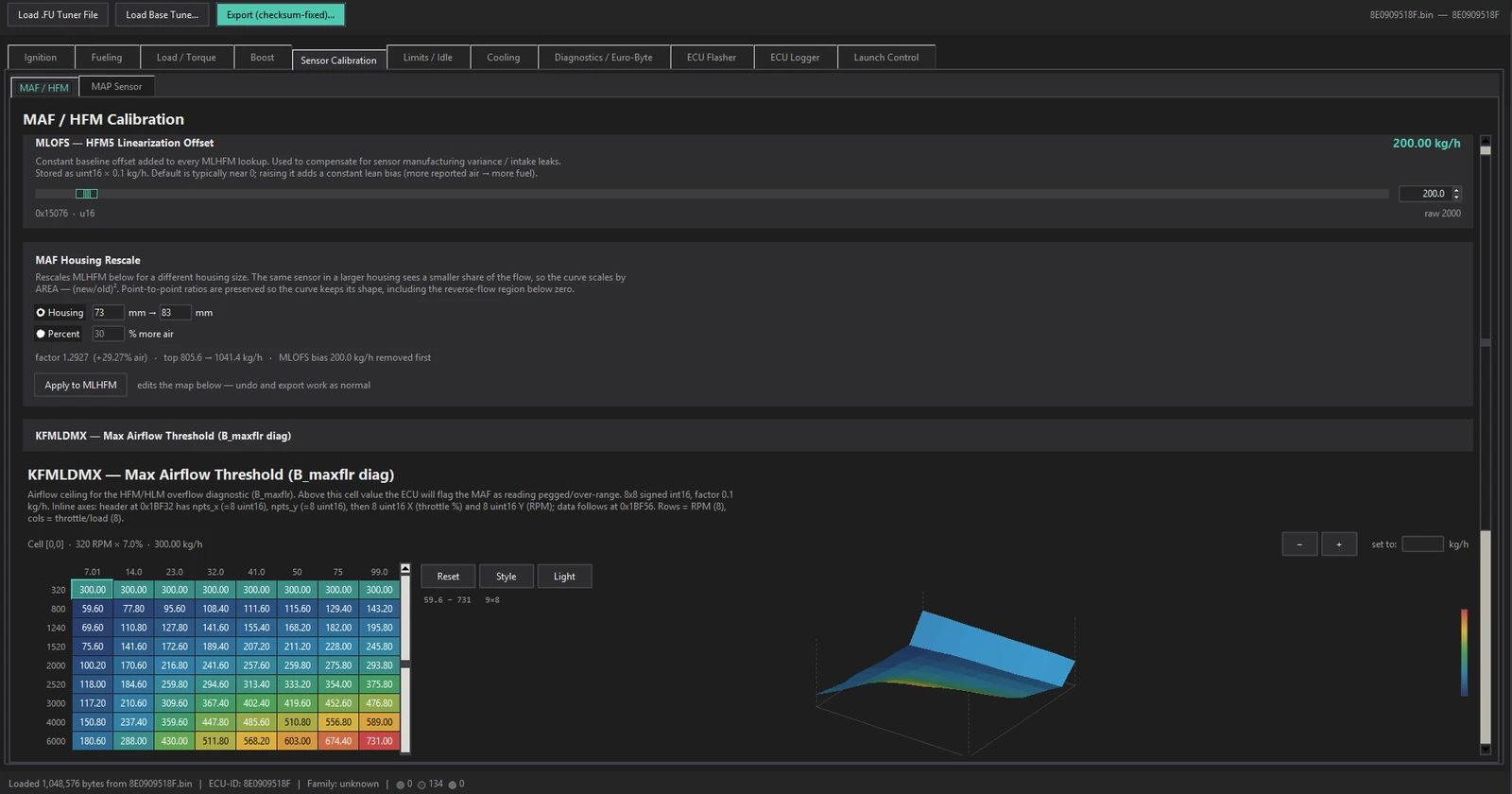
Put an 83 mm housing on a 73 mm sensor and every airflow reading the ECU makes is out by nearly thirty percent. Type both diameters in and it rescales MLHFM by area, holding the point-to-point ratios so the curve keeps its shape — including the reverse-flow region below zero. It strips the MLOFS bias out first and puts it back after, which is the step people miss.
- MAF housing rescale by diameter, or by flat percentage
- MLHFM keeps its shape, reverse flow included
- MLOFS linearisation offset removed before scaling, restored after
- KFMLDMX max airflow threshold, so the ECU stops flagging over-range
- MAP sensor gradient and offset on the next page
Limits & idle
Idle that holds with a big cam
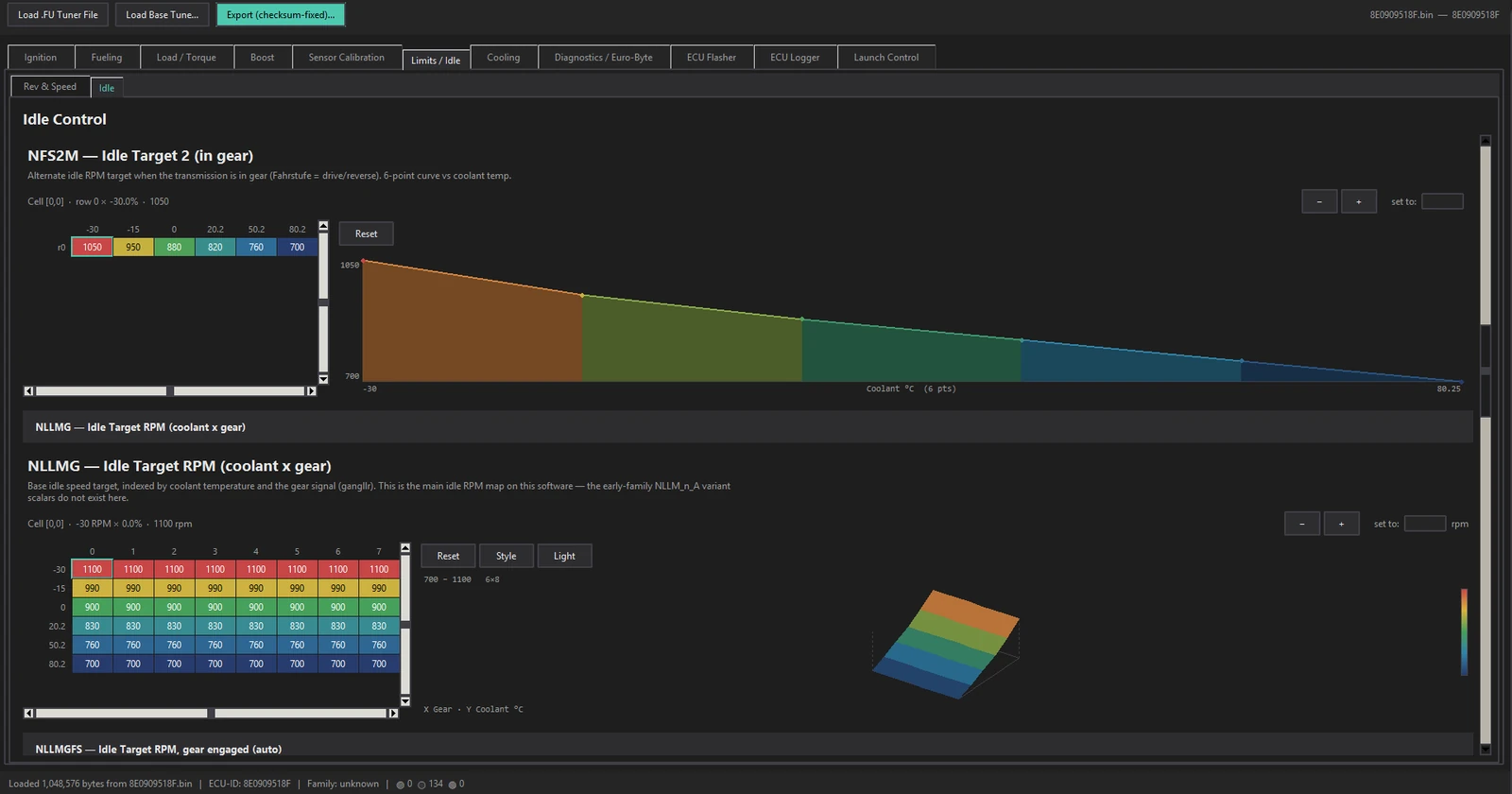
Idle is where most rebuilt engines misbehave. NLLMG sets the base target by coolant temperature and gear, NFS2M handles the in-gear target, and both are drawn as curves so you can see the warm-up ramp instead of guessing at it. Rev and speed limits are on the sister page.
- NLLMG base idle target, coolant × gear
- NFS2M in-gear target, 6-point curve
- Gear-engaged automatic targets
- Rev and speed limiters
Cooling
The thermostat is a calibration
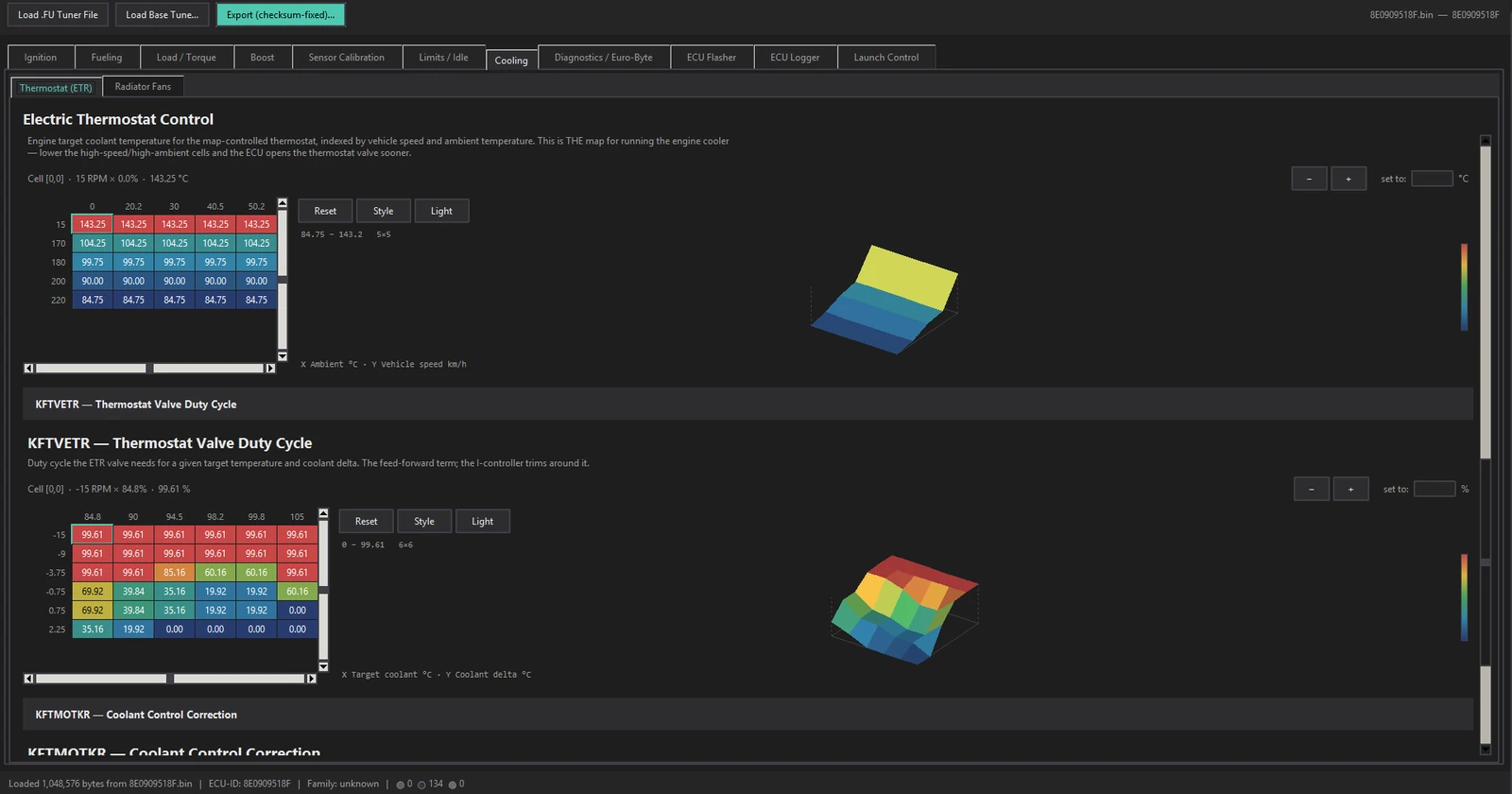
The B6 runs an ECU-controlled electric thermostat, which makes target coolant temperature a map rather than a property of a wax pellet. It is indexed by vehicle speed and ambient temperature, so pulling the high-speed and high-ambient cells down makes the ECU open the valve sooner and the engine run cooler when it is working hardest. KFTVETR underneath is the duty cycle it uses to get there.
- Target coolant temperature by vehicle speed and ambient
- KFTVETR thermostat valve duty cycle
- KFTMOTKR coolant control correction
- KFDQUEBER excess heat for fan control
- KFQNVP1 radiator flow demand per fan
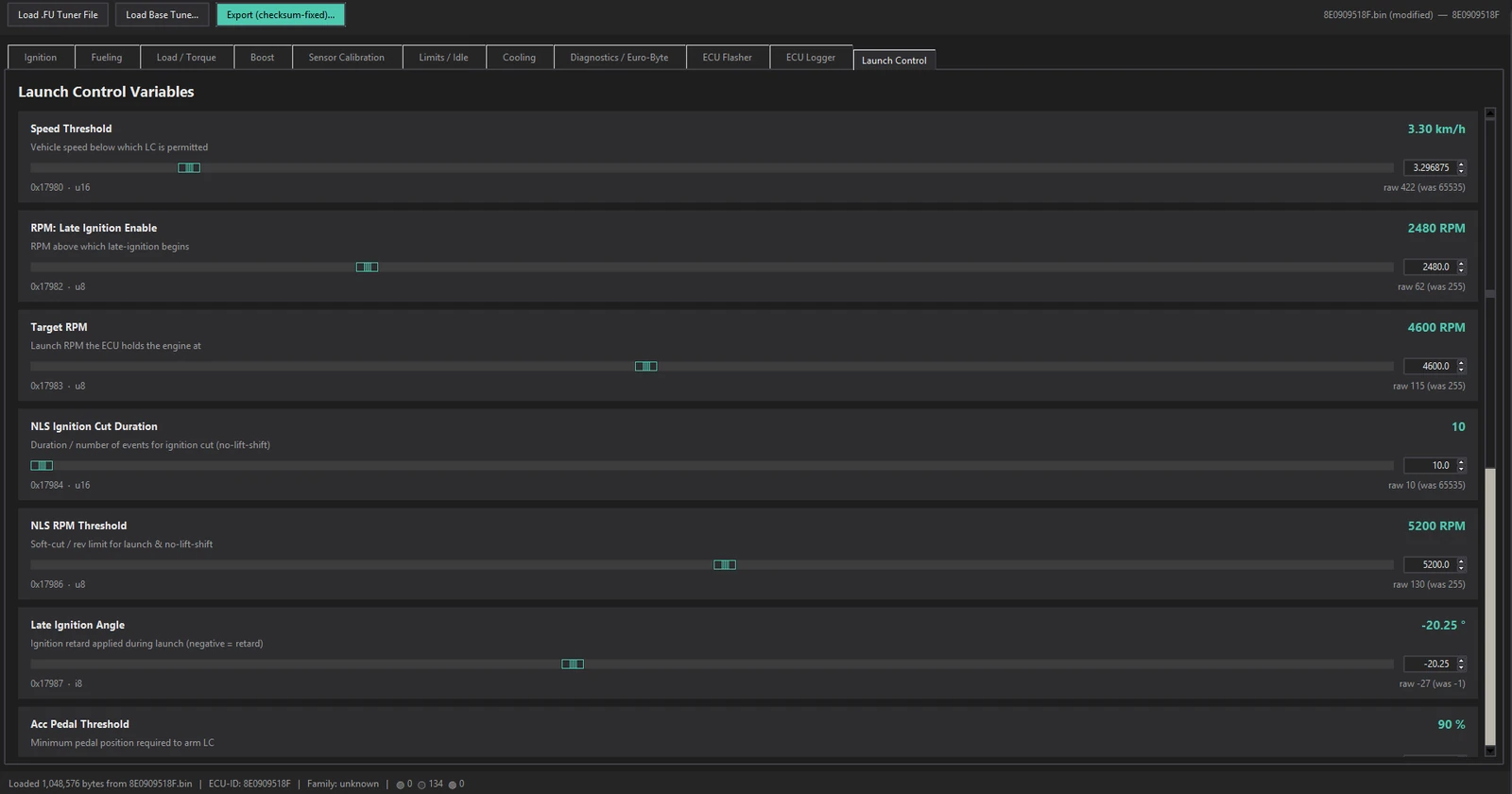
Launch control
Real two-step, not the forum patch
You cannot get real two-step out of map edits alone — it needs code. This is not the NLS patch that has been circulating on the forums for a decade. It is written from scratch, and the things that are hard-coded constants in the public version are parameters here: ignition retard and fuel enrichment during launch are yours to set, and it will not arm on a cold engine.
- Written from scratch, not the recycled public NLS code
- Adjustable ignition retard during launch
- Adjustable fuel enrichment during launch
- Target RPM, NLS threshold and ignition cut duration
- Arms on speed, pedal and coolant temperature
- Left-foot braking via NWPMBBR / VWPMBBR
- Patches a stock bin — verifies every region before writing
Flasher
Read and write over OBD
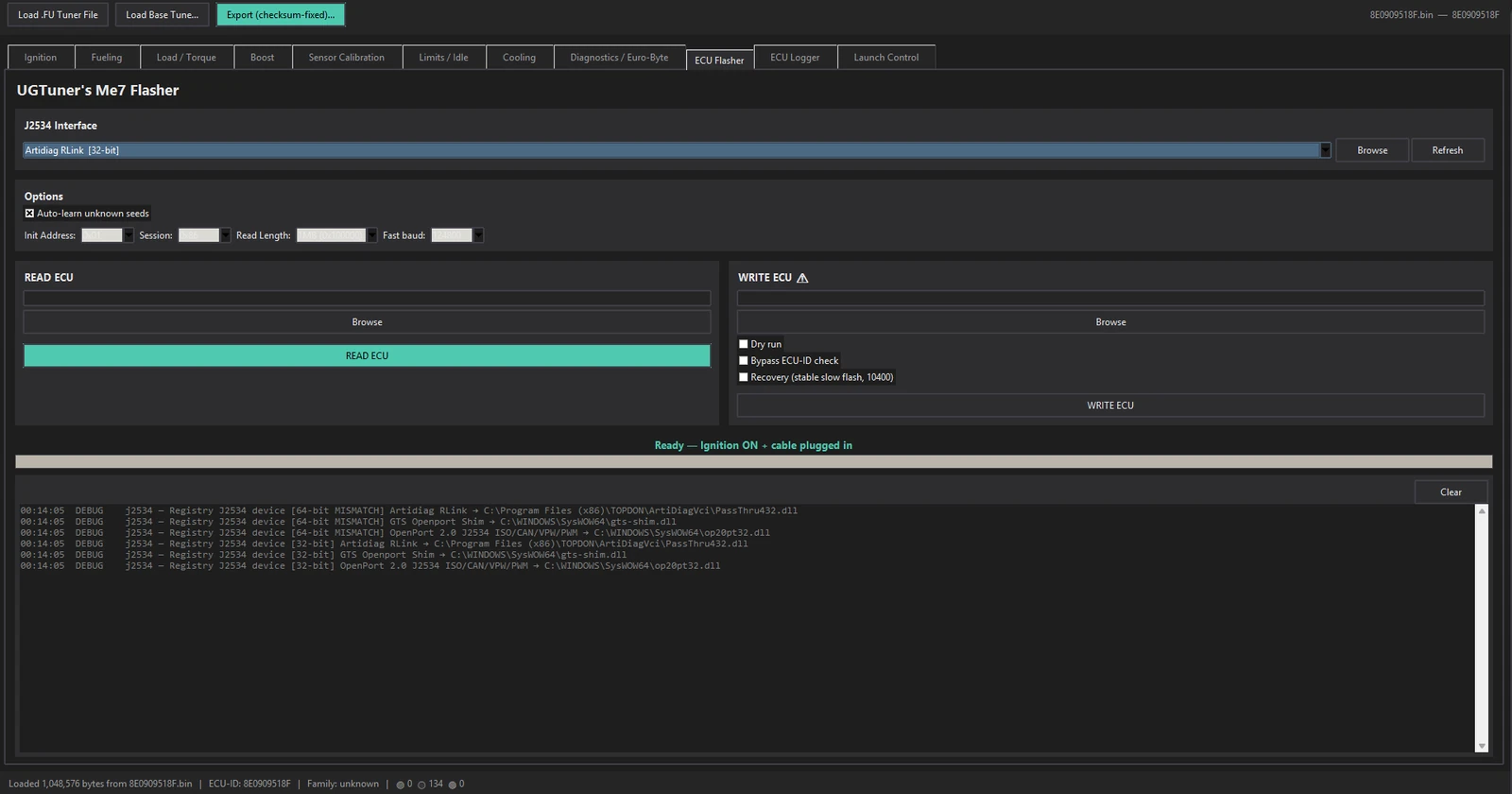
Point it at your J2534 DLL, turn the key on, read the ECU. Writes go sector by sector with recovery points between them, and every frame lands in the console so a failed session tells you what actually happened instead of just failing. Dry run rehearses the whole thing without touching flash.
- Any J2534 device — picker flags 32/64-bit mismatches
- Auto-learn unknown seeds, manual key entry as fallback
- Init address, session, read length and fast baud all exposed
- Dry run before you commit
- Recovery mode — slow, stable flash at 10400
- Full debug console you can send me
Logger
Live data while you drive
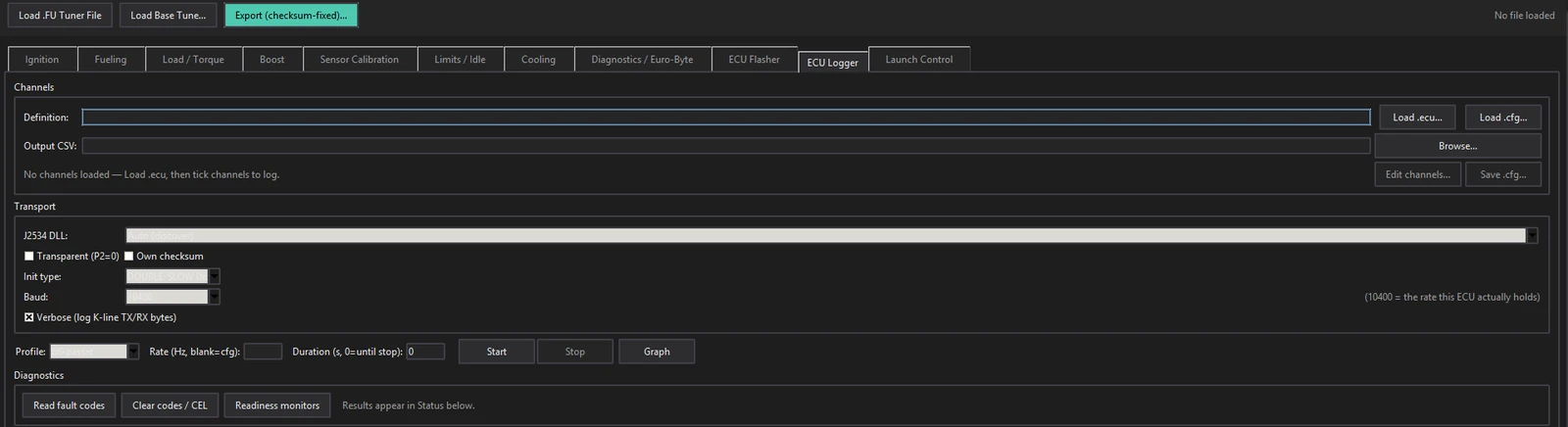
It reads ME7Logger .ecu and .cfg files, so definitions you already have keep working. Pick your channels, pick a rate, record until you stop or for a set duration. Output is CSV that opens in any log viewer, with the German channel descriptions translated to English.
- Loads existing .ecu definitions and .cfg profiles
- Channel picker with filter and bulk select
- Built-in profiles: A-chassis NB and WB, B5 S4, B6
- Live values plus a pop-out graph window
- Verbose mode logs raw K-line TX/RX
- Fault codes, CEL clear and readiness monitors
Throughout
Same editor everywhere
Every map is a heat-shaded grid with a pop-out 3D surface on the same colour ramp, so a cell that reads orange in the table is orange on the surface. Shared axes get flagged before you edit one and move six other maps with it. Export corrects the checksums and then checks its own work — no separate tool, no plugin licence.
- 2D grid and pop-out 3D surface
- Warns when an axis is shared
- Curated base tunes to start from
- Checksum correction built in, then verified
- .FU container for the flasher
Which build
you need
Which one you need comes down to production year. Check the number on the ECU label, or pull it with the diagnostics tab — the tool will not write a file that does not match the build you are running.
| Build | ECU number | Production | Fitment | Supported |
|---|---|---|---|---|
| Early | 8E0909518F | 2002 | A4 B6 1.8T | Read & write |
| Late | 8E0909518AL / AK / AT / BC | 2003 onward | A4 B6 1.8T | Read & write |
Confirm the late-build list against files you have actually opened before this goes live.
Cables
it works with
Any J2534 pass-through that can do ISO9141 / KWP2000 on K-line. The tool drives the cable through its own PassThru DLL, so if the manufacturer ships a working driver it will work.
Any J2534 pass-through
It has to speak ISO9141 / ISO14230 on K-line. Tactrix OpenPort 2.0 and Topdon ArtiDiag both work. Browse to the DLL, or let it find one in the registry.
Use the 32-bit driver
The tool is a 32-bit build, so it needs the 32-bit PassThru DLL. The device picker flags a 64-bit mismatch up front rather than failing halfway through a session.
Not supported
Dumb FTDI or KKL 409.1 cables, Prolific clones, and anything CAN-only. There is no raw-serial path — the ECU needs a K-line handshake these cannot do.
Read this before you flash
- Save a full read of your stock file and keep a copy somewhere other than the tuning laptop. It is the only way back.
- Put a charger on the battery. Voltage sag mid-write is the most common way this goes wrong.
- Close everything else, turn off sleep, and do not unplug the cable while a write is running.
- If a write does get interrupted, the ECU needs boot-mode recovery on the bench. This tool does not do boot mode — that is a separate job with a separate rig.
- Sold for off-road and competition use. What you do with it on a road car is on you.
New to ME7? Read the S4wiki tuning guide before you change anything. This tool gives you the maps; it will not tell you what to put in them.
Buy
Sold direct, by email. No cart and no account — tell me which ECU you have and I will send the file and the invoice.
Tuner + stock file
$80
One-time, one PC
- The full suite — editor, flasher, logger
- Launch control patch included
- A verified stock file for your ECU
- Updates and email support
Tuner + tuned file
$150
One-time, one PC
- Everything in the $80 tier
- A stage 1 or stage 2 file built for your setup
- Tell me your hardware and I build to it
- Updates and email support
Custom calibration
Contact
Quoted per job
- Big turbo and out-of-the-box builds
- Mode switching
- Injector, MAF and MAP rescaling to suit
- Priced on what the job actually needs
How “one PC” works
The suite is licensed to the machine you install it on. First run shows a Hardware ID; send me that and you get a licence file back, which you drop next to the program. It is checked offline — nothing is transmitted, and there is no dongle, no account and no time bomb.
Changed motherboard, rebuilt Windows or moved to a new laptop? Email me the new Hardware ID and I will reissue it. That is included, not a second purchase.
Locked to one PC, not to one car. You send a hardware ID, I send back an activation
file — no internet check, no dongle, nothing phoning home.
Questions before you buy? ugtperformanceusa@proton.me — send your ECU number and what the car is running and I will tell you straight whether this does what you need.